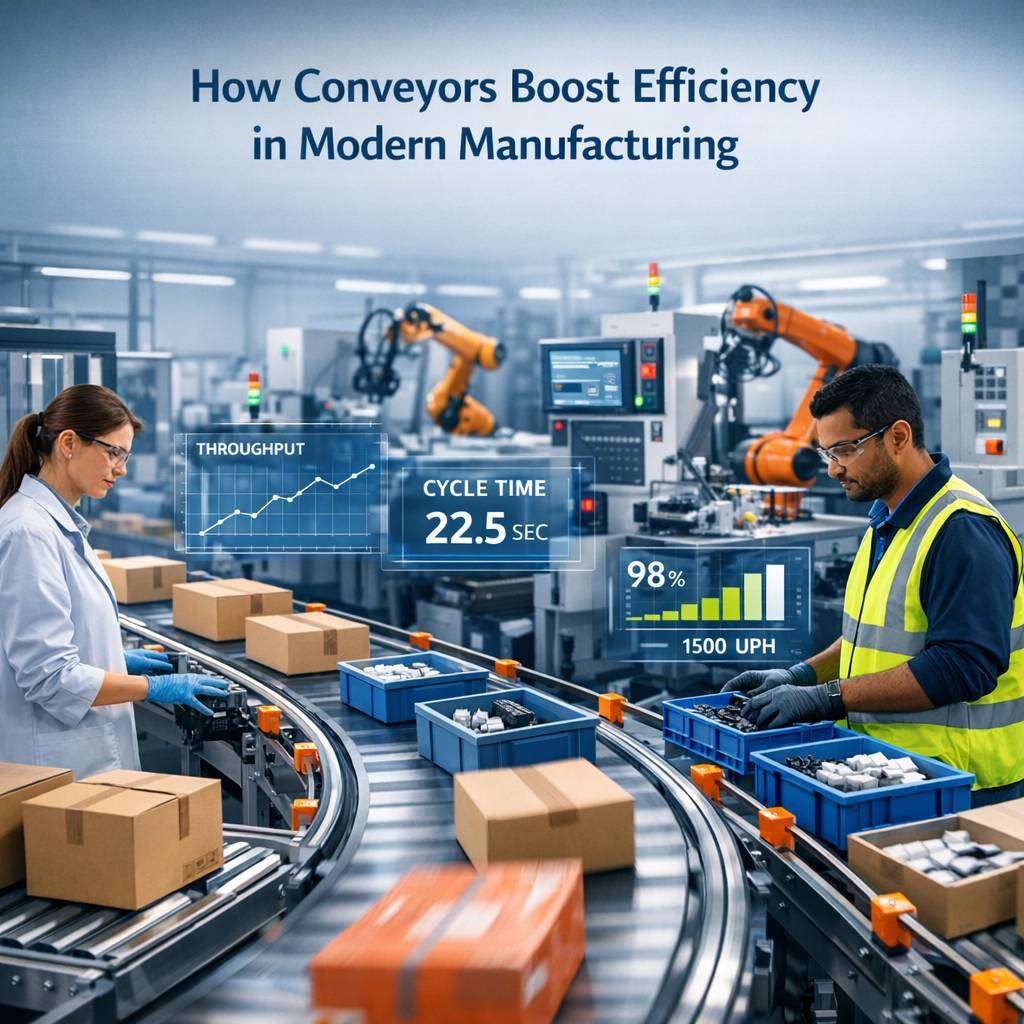
In contemporary manufacturing, the movement of materials is as critical as the production of goods themselves. Conveyor systems have evolved from simple gravity-driven belts to sophisticated, integrated networks that synchronise with robotics, asset management software, and lean manufacturing practices. As an expert in industrial engineering, I will explore how conveyors contribute to operational efficiency, product quality, and total cost of ownership across diverse sectors.
The strategic role of conveyor systems in production lines
Conveyor systems are the backbone of material handling within factories. They provide a reliable, repeatable means of transporting products between workstations, storage areas, and packing zones. The predictable flow minimises manual handling, reduces the risk of bottlenecks, and enables planners to sequence processes with greater precision. Modern conveyor configurations—such as belt, roller, chain, and overhead systems—can be tailored to the product profile, from light, delicate items to heavy, rigid components. By aligning the pace of material movement with takt time, manufacturers can sustain a steady rhythm that supports higher throughput without sacrificing quality.
Labour efficiency and ergonomic benefits
One of the most direct ways conveyors boost efficiency is by improving labour utilisation. Automated transport allows operators to focus on value-added tasks—such as inspection, assembly, or packaging—rather than pushing, lifting, or carrying items. This shift not only accelerates production but also enhances workplace safety and ergonomics. For example, conveyors reduce repetitive strain injuries by taking over repetitive motions, while gravity or powered conveyors lower the need for manual carts and forklifts in congested areas. In high-mix, low-volume environments, modular conveyor systems can reconfigure quickly to accommodate different products, enabling a single production line to support multiple SKUs with minimal downtime.
A conveyor system streamlines busy kitchens by moving items smoothly from prep to plating. It boosts throughput, standardizes cooking times, and reduces labor costs without sacrificing consistency. Operators appreciate the gentle, continuous action that minimizes damage to delicate foods while handling peak orders. For durability and reliable performance, many kitchens rely on modern conveyor solutions designed to fit space and workflow. In particular, versatile equipment like this supports efficient, scalable food prep. https://www.waring.com/conveyor-toaster/CTS1000.html
Synchronisation with automation and robotics
Conveyor systems excel when integrated with automation and robotics. Robotic arms can pick items from a moving conveyor, perform assembly tasks, or place finished goods into packaging lines. Conversely, conveyors can be designed to deliver parts precisely to robotic cells, ensuring repeatable pick-and-place operations. This collaborative interaction reduces cycle times and elevates process reliability. For high-precision manufacturing, servo-controlled conveyors offer accurate positioning, while zero-pressure accumulation (ZPA) conveyors manage flow without damaging delicate products. The ability to harmonise conveyors with sensors, actuators, and control systems creates a responsive, adaptive production ecosystem that can automatically adjust to variations in demand or supply.
A high-efficiency conveyor system can transform material handling, boosting throughput and reducing labor costs. Operators appreciate durable components, smooth startup, and minimal maintenance across shifts. With scalable configurations and ergonomic layouts, facilities achieve consistent flow and safer work environments. For expert solutions and premium parts, visit https://conveyorrollers.co.uk.
Quality control and traceability
Efficient conveyor systems contribute to quality assurance by standardising movement and enabling exposure of every item to inspection steps. Integrated vision systems, scanners, and check-weigh stations can be positioned along the line to monitor dimensions, weight, and surface integrity in real time. Conveyors can also support segregated flows for defect containment, ensuring that non-conforming items do not contaminate the main product stream. With connected data capture, manufacturers gain end-to-end traceability—essential for regulated industries and for continuous improvement initiatives. The data can be analysed to identify recurring issues, optimise routes, and reduce scrap. As a result, conveyors become not just transport devices but active components of a quality-driven manufacturing culture.
A conveyor system streamlines production, boosting efficiency and consistency across batches. Delicate items glide smoothly, minimizing manual handling and waste while meeting strict timelines. For reliable equipment that speeds up toasting, explore options and trusted brands. https://www.hatcocorp.com/en/equipment/cooking-equipment/commercial-toasters/toast-king-conveyor-toaster-tk
Conveyor systems streamline efficiency on busy production floors, aligning tasks and reducing manual handling with precise automation. Workers benefit from safer workflows, faster throughput, and consistent quality as components move smoothly from station to station. In modern facilities, integrating smart controls and real-time monitoring elevates performance and minimizes downtime. For mobile access and dictation integration, explore the following resource in the second half: https://apps.apple.com/us/app/conveyor-ai-emr-dictation/id1528999268.
Optimisation of space and energy use
Space utilisation is a critical constraint in modern factories. Conveyors enable vertical and horizontal routing that maximises floor space and minimises handling distances. Overhead and mezzanine-mounted conveyors free valuable floor space for equipment or storage, while compact, modular designs allow rapid reconfiguration as product families evolve. Energy efficiency has also improved markedly; modern drive systems use variable-speed drives (VSDs) and regenerative braking to minimise power consumption. In some applications, gravity conveyors or light-duty belt systems offer low-energy pauses in operation, further reducing the total energy footprint. With careful design, a conveyor network can be parallelised, providing alternative routes that maintain throughput during maintenance or downtime on one section.
A reliable conveyor system can transform warehousing efficiency, improving throughput and reducing manual handling. From initial design to ongoing maintenance, selecting the right solution minimizes downtime and operational costs. For industry-leading options and expert guidance, explore your best-fit solution here: conveyor.
Maintenance, reliability, and total cost of ownership
A well-engineered conveyor system reduces downtime through robust components and proactive maintenance. Wear parts such as belts, rollers, and bearings are predictable maintenance items, and condition monitoring can forecast failures before they occur. Modular conveyor systems simplify repair work and spare parts management, limiting the duration of line stoppages. Reliability is enhanced through redundancy and intelligent controls; for example, Smart Motor Controllers and diagnostic software can alert operators to performance deviations, enabling pre-emptive adjustments. While the initial capital expenditure for conveyor systems may be significant, the long-term benefits—lower labour costs, reduced scrap, higher throughput, and improved uptime—often yield a compelling return on investment. In practice, evaluation should include uptime metrics, energy costs, maintenance labour, and the impact on overall equipment effectiveness (OEE).
Customisation for industry-specific demands
Conveyor systems are not one-size-fits-all. Different industries impose unique requirements: cleanability and corrosion resistance in food and pharmaceutical sectors, explosion-proof designs in hazardous environments, or clean-room compliant configurations in electronics manufacturing. Safe and ergonomic design considerations—such as guarding, emergency stops, and process contamination controls—are integral to any successful deployment. Conveyor suppliers offer a spectrum of options, from conveyor belts with anti-macterial coatings to wash-down-capable units and hygienic stainless steel frames. The ability to tailor conveyors to product geometry, timing constraints, and environmental conditions is central to realising efficient, reliable operations.
In short, conveyors are not merely equipment for moving parts; they are strategic enablers of efficiency in modern manufacturing. Through improved material flow, enhanced operator productivity, seamless automation integration, robust quality controls, and optimised space and energy use, conveyor systems support a lean, responsive, and data-driven production environment. When designed and maintained with attention to product, process, and people, conveyors deliver substantial gains in throughput, quality, and total cost of ownership across diverse manufacturing landscapes.