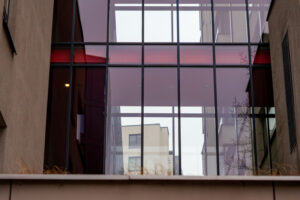
One cracked pane in a twenty-five-year-old glazed roof sounds like a small job. It is, right up to the point where someone has to work out what glass was in it, and then it becomes an identification exercise with a procurement problem on the end.
The replacement has to fit the frame, carry the same loads, meet current requirements for overhead glazing, and look like the panes around it. Hitting all four is harder than it sounds, and the last one is the one that gets left until the glass arrives.
What has to match, in order of consequence
Thickness and build-up come first, because they decide whether the unit goes in the frame at all. A glazing system is designed around a particular overall thickness, and the gasket and rebate won’t take much deviation from it.
Structural capability is next. The glass has to carry the wind and snow loads the roof sees, and in a roof that means it isn’t a free choice.
Then the safety requirement. Overhead glazing over a space people use needs to behave in a particular way when it breaks, and current practice is laminated glass or a laminated inner leaf for that reason. If the original was toughened throughout, the replacement probably shouldn’t be, which means the new pane will not be a match for the old ones in construction even though it has to match in appearance.
Thermal performance comes in fourth and sometimes brings an upgrade obligation with it. A modern unit in a roof full of older ones can also behave differently in the sun, which matters more than people expect.
Appearance is last in the technical order and first in the complaints. Which is the problem.
Why the new one looks different
Three things cause the mismatch, and all three are properties of the glass rather than of the installation.
Coatings have changed. Solar control and low-emissivity coatings from twenty-five years ago are not the coatings available now, and their reflected colour differs. A modern coating in an older roof can read as noticeably bluer or greener from certain angles, and nobody notices which angles until the scaffold comes down.
Glass has got clearer. The iron content of float glass has come down over the decades, so older glass tends to carry a greener cast in thickness that newer glass doesn’t. In a roof seen edge-on across a long span, that shows.
And the old glass has weathered. Twenty-five years of pollution, cleaning and UV leaves a surface that a factory-fresh pane sitting next to it will not match, whatever was specified.
What can actually be done about it
Four options, and they’re all compromises of different shapes.
Identify and source as close a match as the current product range allows. This is the usual answer and it depends entirely on knowing what’s there, which means reading the spacer bar and taking a sample if one can be had. A good glass supplier can often get close on a coating family even where the exact product is long discontinued.
Accept the difference and place it where it matters least. On a large roof, a pane in a corner reads very differently from one in the middle of a run. Worth discussing before the position is chosen for access convenience.
Replace a run rather than a pane. If the roof is organised into bays, replacing a whole bay moves the visible join to a structural line where the eye expects a change. Costs more and often looks far better.
Plan a phased reglaze and treat the broken pane as the first phase. On a roof where the units are near the end of their lives anyway, this is frequently the decision that should have been made before the glass broke.
Where the identification actually happens
Not from the floor. The spacer bar carries markings, the glass may carry an edge mark, and the build-up can usually be measured at an edge, but all of that needs someone at the glass with close access.
An older roof with no records is the common case. The installing contractor may be gone, the drawings with them, and what’s left is whatever can be read in situ. That’s a survey rather than a visit, and it’s the step most often skipped before an order goes out.
Guidance from the Centre for Window and Cladding Technology covers how glazed envelopes are assessed, and the Glass and Glazing Federation publishes guidance on glass selection for overhead applications. Neither will tell you what’s in your roof.
The access and the glazing being held by the same firm matters more here than on most jobs, because the identification, the ordering and the installation all depend on the same close look. Specialists such as https://skyaccessglazing.co.uk/commercial-glazing-services/high-level-glass-replacement can do the survey and the replacement under one scope, which avoids a second mobilisation purely to measure.
Older buildings usually have other glazed elements of the same vintage with the same identification problem, and how architectural glazing products advanced energy efficiency in commercial projects covers what changed and roughly when, which is useful for dating what you’ve got.
Order the pane after the survey, not before. A unit made to a guessed specification is a unit that gets lifted thirty metres, tried, and taken down again.